Showing posts with label pelvis. Show all posts

Friday, 4 September 2015

Thoughts on Trikonasana


Here I want to show you how I practice trikonasana and maybe give a few reasons why.

First, my main focus in all of my postures is that I have an internal feeling of freedom and lightness.  This is both a physical feeling and mental one.  I tend to let my body adjust itself from there.  

But when you are newer to yoga sometimes you have to focus on specific parts and narrow your focus of attention.  Over time the skill is in narrowing and broadening and being able to shift and integrate and come to some point of non-thinking mindfulness.  I still work at that.  

But back to the topic at hand, which are just some thoughts on the relationship between what you do with your pelvis and how that affects movement at the hip and what you see at the thigh in a pose like trikonasana. 

I made a video as that is the best way to explain.  Have a look and then I have written some commentary below.


Set up
I set my front foot up along an imaginary mat so that the outer edge of the front foot is parallel to the outer edge of that imaginary mat.  My back foot ends up toe down then heel down (mindful and slow movement) so that an imaginary line (lots of those going on in yoga and you get the sense of how yoga can train your sense of position in space when you consider all of the internal imagining and feeling that is going on) exists from the front heel towards the heel or back half of the back foot.  My foot is at an angle.  Other people do different things with their feet.  I try to figure out where my knee feels comfortable.  

With my front heel set like that I can try to grip the heel inwards.  That contributes to a feeling that the thigh rolls out.  You will feel some firmness around the outer hip joint.  
Front thigh rolling out.  Knee looks more like it is pointing towards outer edge of foot.

This rolling out is what I wanted to focus on in this post.  There is obviously a lot more going on in trikonasana.

If you know what you are doing you can actively just think about rolling your thigh out and it will happen. I show this a few times in the video how I can roll the thigh out or let it roll back in. 
The front thigh rolling in, with knee more over the inner edge of foot.  I avoid this in trikonasana.

Ultimately, the thigh bone sort of makes an imaginary line that is going more on the outer side of my foot rather than on the inner edge. 

Relationship of moving back pelvis to what happens in front hip joint complex
In the video I move my hand to touch the front of back pelvis.  Then I start to move that back, as many people do in an effort to get their pelvis pointing to the side. 

You can see what happens to my front thigh if I do that though.  I rolled my pants up so you can see clearly what happens and where the knee starts to point.  
What happens to front thigh when I try to take back pelvis back.  This is what I avoid in trikonasana.

Most people will also start to feel some stretch along the inner thigh as well.  

The act of moving the pelvis back is going to have an impact on what happens at the hip joint.  

In this case you start to get thigh rolling in at the front hip rather than the rolling out that we are looking for.  

So what?
So what I say is don't worry about where you think your pelvis should be facing.   

Most people will ultimately have their pelvis in more of a diagonal facing position--how diagonal is up to your own body.  
Front thigh rolling out.  Back pelvis comes around.  Pelvis neither pointing straight to front nor directly to side.  It is in a happy place in between.
I tend to instruct bringing the pelvis around a little so that you can get good activation in the front hip joint complex and so you do not feel the sensation of stretch in the front inner thigh.  

Roll your back thigh in.

Then, activate your legs by stretching the ground with your feet (trying to push the feet down and away from one another).  

Feel that your lower back is free.  Feel that you are firm but calm.  

You could stay there or you could start to move actively from your spine to turn towards the sky.  I turn while lengthening and not squashing the spine.  

I reach my fingers as far away from the centre of my chest as possible.

Inside I am singing and smiling and feeling like I am doing something but happy and calm and free.  

This is how I practice.  This is how I try to help you feel in class.  


Join us for Canberra Outdoor Yoga classes each week of join me for retreats in Sri Lanka where I teach principles of active movement, free spinal movement, and generally helping your body sing from the inside so you move happier and healthier.

Do not do anything that hurts.  Remember, these posts are mainly intended for my students as practice notes.  It is best to learn from an actual teacher and not from the internet. 

Much metta,
Samantha
www.yogacafecanberra.blogspot.com
www.yogacafelk.blogspot.com

Monday, 3 August 2015

Baby Backbend Without Squashing Lower Back


I have never had a problem with urdhva dhanurasana.

But I have had lots of students who have or do have difficulty with it.  

One thing I always emphasise is the spine should not feel squashed at any part or at any point from ground to lift and down again.  

People can tend to squash in their lower backs. 

I have even had people tell me they thought it was supposed to squash their lower back.

I tell people they are practicing something else but not the pose I am trying to teach if they feel squashing.  

If you are in my class I want you to remember a few things when it comes to this part of the sequence.

Practice without squashing.

Don't be attached to the outcome.

Move slowly.

With this in mind, a part of not being attached to the outcome is realising you don't need to do anything at all if it does not feel right.  

You certainly don't need to come all the way up.

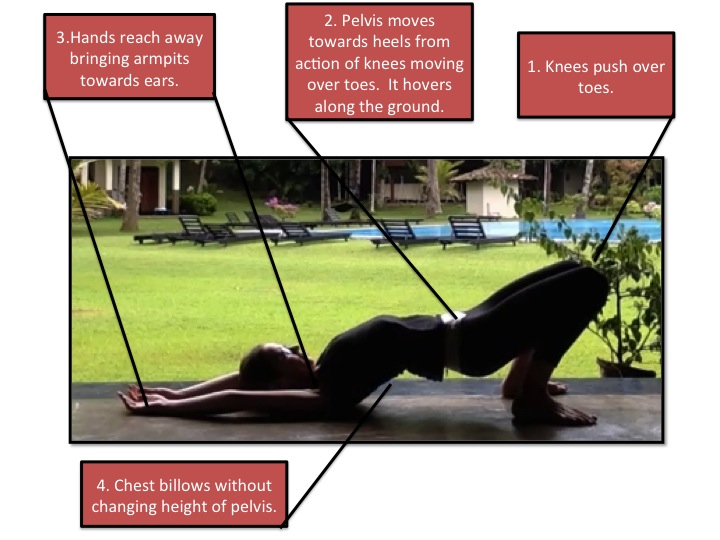
With this in mind, I made a  poster that shows what you could pay attention to if you decide not to push your hands into the floor.  There is still plenty you can do and, in fact, I do these things each time I come up into a fuller posture, as you can see in the video at the end (it's just that I only need to spend about a second getting there whereas some people will need more time).

Please bear in mind this post is intended primarily for my students who can experience what I am teaching in a class situation.  Learning this type of thing from the internet is not suitable. 

Read the poster from the right starting with what to do with the knees.


If you lie on your back and just press your feet into the floor you will feel your pelvis get light without necessarily lifting.  Then press your knees over your toes.  

The pelvis will lift and be carried towards the heels.  I am not trying to push my pelvis up here.  There are many styles that teach this and it is possible and there are benefits to that as well but it is not what I am doing here.  

I then reach my arms as far away from my pelvis as possible.  I try to basically get as long as I can through my body--pelvis moving one way and armpits the other.

Then I try to billow up my chest as though a gust of wind has blown through my feet and hits me in the middle of my upper back causing it to lift.  

This is where I like to get people to stop and think for a while.  Moving this part of the spine is really tough.  It is the stiff part of most people's spines.  

Many people cannot get movement in this part of their spine at all unless I provide a tactile cue (touching the area).  Often people shove their pelvis up and down and their chest moves as a consequence but there is little to no independent movement in the upper spine.  

What I am trying to do for myself when I practice this way is get some independent movement of the chest so that my spine does not move as one chunk.  

It is delightful just to try to raise and lower the chest here without moving the pelvis and just continue reaching the arms in one direction while moving the knees in the other.  

But you decide.  

Don't do anything that hurts or strains.  

Most people will need to do a lot of 'warming up' before they can do the full version of the pose but you can do this modified variation any time.  

Having said that, my teacher Paddy always taught me that they should feel so free you can do the full posture first thing in the morning when you get out of bed.  I do that myself every now and then.  I am not saying I don't feel a bit stiff in the morning but in my experience she is right, when you are able to move freely then this is possible.  Being able to move freely takes a lot of practice though and I still have stiff mornings!

Also, when you practice this way there should have been no squashing so no need to do something to unsquash your back afterwards.  

Below is a video of the full thing, taken on location in Sri Lanka at my last yoga retreat.  I will be heading there, by the way, for my next yoga retreat from 1-4 October 2015.  Get in touch if you'd like to join us!


This post is not intended to cover all of the aspects of back bending.  I wanted to emphasise a pose you can try on the floor without raising to the full posture that helps you lengthen.  There is, of course, much more you can do within that even (did I mention doing a sit up in your tummy?), but that is for class!

Happy and safe practicing.

Much metta,
Samantha
www.yogacafecanberra.blogspot.com
www.yogacafelk.blogspot.com