Showing posts with label urdhva dhanurasana. Show all posts

Monday, 3 August 2015

Baby Backbend Without Squashing Lower Back


I have never had a problem with urdhva dhanurasana.

But I have had lots of students who have or do have difficulty with it.  

One thing I always emphasise is the spine should not feel squashed at any part or at any point from ground to lift and down again.  

People can tend to squash in their lower backs. 

I have even had people tell me they thought it was supposed to squash their lower back.

I tell people they are practicing something else but not the pose I am trying to teach if they feel squashing.  

If you are in my class I want you to remember a few things when it comes to this part of the sequence.

Practice without squashing.

Don't be attached to the outcome.

Move slowly.

With this in mind, a part of not being attached to the outcome is realising you don't need to do anything at all if it does not feel right.  

You certainly don't need to come all the way up.

With this in mind, I made a  poster that shows what you could pay attention to if you decide not to push your hands into the floor.  There is still plenty you can do and, in fact, I do these things each time I come up into a fuller posture, as you can see in the video at the end (it's just that I only need to spend about a second getting there whereas some people will need more time).

Please bear in mind this post is intended primarily for my students who can experience what I am teaching in a class situation.  Learning this type of thing from the internet is not suitable. 

Read the poster from the right starting with what to do with the knees.
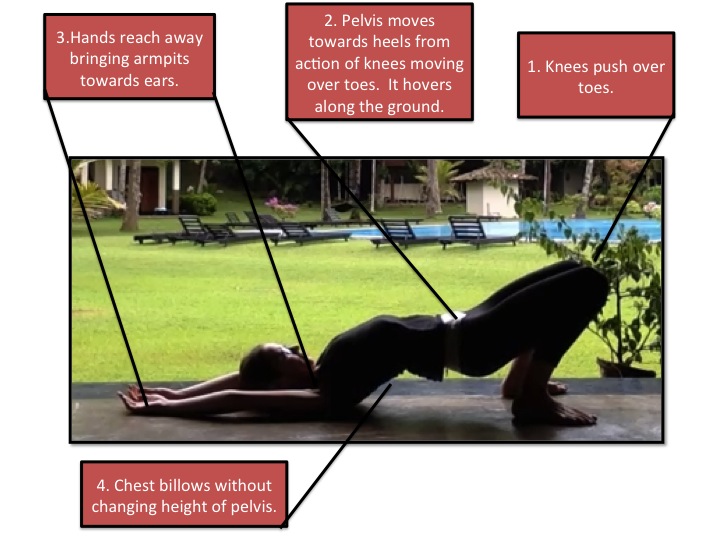

If you lie on your back and just press your feet into the floor you will feel your pelvis get light without necessarily lifting.  Then press your knees over your toes.  

The pelvis will lift and be carried towards the heels.  I am not trying to push my pelvis up here.  There are many styles that teach this and it is possible and there are benefits to that as well but it is not what I am doing here.  

I then reach my arms as far away from my pelvis as possible.  I try to basically get as long as I can through my body--pelvis moving one way and armpits the other.

Then I try to billow up my chest as though a gust of wind has blown through my feet and hits me in the middle of my upper back causing it to lift.  

This is where I like to get people to stop and think for a while.  Moving this part of the spine is really tough.  It is the stiff part of most people's spines.  

Many people cannot get movement in this part of their spine at all unless I provide a tactile cue (touching the area).  Often people shove their pelvis up and down and their chest moves as a consequence but there is little to no independent movement in the upper spine.  

What I am trying to do for myself when I practice this way is get some independent movement of the chest so that my spine does not move as one chunk.  

It is delightful just to try to raise and lower the chest here without moving the pelvis and just continue reaching the arms in one direction while moving the knees in the other.  

But you decide.  

Don't do anything that hurts or strains.  

Most people will need to do a lot of 'warming up' before they can do the full version of the pose but you can do this modified variation any time.  

Having said that, my teacher Paddy always taught me that they should feel so free you can do the full posture first thing in the morning when you get out of bed.  I do that myself every now and then.  I am not saying I don't feel a bit stiff in the morning but in my experience she is right, when you are able to move freely then this is possible.  Being able to move freely takes a lot of practice though and I still have stiff mornings!

Also, when you practice this way there should have been no squashing so no need to do something to unsquash your back afterwards.  

Below is a video of the full thing, taken on location in Sri Lanka at my last yoga retreat.  I will be heading there, by the way, for my next yoga retreat from 1-4 October 2015.  Get in touch if you'd like to join us!


This post is not intended to cover all of the aspects of back bending.  I wanted to emphasise a pose you can try on the floor without raising to the full posture that helps you lengthen.  There is, of course, much more you can do within that even (did I mention doing a sit up in your tummy?), but that is for class!

Happy and safe practicing.

Much metta,
Samantha
www.yogacafecanberra.blogspot.com
www.yogacafelk.blogspot.com

Saturday, 21 March 2015

Backbends Without Squashing


I have written about armpits many times before.  There are more things to talk about with regards to actions at the shoulder joints but the armpits are so key and I have focussed on them in our course.

One of the key things to appreciate is that how you use your armpits, depending on shoulder position, can impact on the spine.  If you take your arms overhead, I take armpits forward and up and NOT down and back.

In an overhead position armpits forward and up will help create length in the spine.

If you take them down and back while arms are overhead, or even down, you get a shortening feeling around your sides and back.

To come into more difficult postures where the arms are overhead you need to free up your armpits so the spine can move freely.

Some backbends happen with the arms below shoulder height, like ustrasana or bhujangasana for instance.  In those types of positions, because arms are not overhead, I take armpits down and back.  The video below shows how I can do backbends with armpits down and back, as I would in backbends like bhujangasana, or forward and up, such as I would in urdhva dhanurasana.

In the video I also show how you can actually come into a pose like urdhva dhanurasana with armpits either towards ears or with armpits towards hips.  I do this to illustrate a point that it can be done, not necessarily that it should be done.


As I show, because I have a fairly fluid spine it does not create difficulty for me to come into an overhead backbend like urdhva dhanurasana with armpits down.  But it does not feel as good as it could either.

The thing is most people (either coming to yoga or not) tend to be stiff in their spine in general, and move most from their lower back.

Doing urdhva dhanurasana with the armpits to the hips (downs and back) can reinforce the shortening many people already experience.

So, in my classes I encourage armpits to ears to generate the length in the spine.

Again, because I am fairly mobile around my armpit area, especially when I take them overhead, I can easily come up into a full backbend with armpits to ears.

People who are tighter around the armpits will find that they cannot come up so easily and I suggest you only come up to the point where you feel at ease in your spine.  This might mean the shoulders barely come off the floor and you just lift a little, as I also show in the video.

These are not things to practice without the guidance of an experienced practitioner so I encourage you to go to one.  I would encourage you to feel in your own body what is going on and if you come out of a backbend with a sore lower back to question what has gone on to create that as it should not be squashing.

In our classes this week we also looked at some of the basic movements at the shoulder joint--shoulders rolling in and shoulders rolling out.  We looked at how these movements can cause associated movements in the upper back (thoracic spine).  We looked at how these associated movements can be over-ridden if we call attention to them.

For instance, rolling the shoulders in tends to cause the upper spine to round as though bending forward.  We can try to lift the chest softly to help bring the spine back to upright.

When rolling the shoulders out it tends to cause the upper spine to arch as though back bending but that we can also over-ride this if we are conscious of it by softly drawing the lower ribs in.

Understanding these associated movements will help you learn to move your spine independently of shoulders for better and more active spinal movement.  I will post more about this later.  The armpits are a lot to think about already!

I had to laugh at myself when I re-watched the video.  I am not sure how my voice turned into a David Attenbourough-esque commentary.  Perhaps it is because I feel so wonderfully passionate and when that happens and you try to explain something it does something funny to your voice.  Well, to mine anyway,  Also to my eyebrows!

We will practice these actions in my classes, workshops, and retreats in Canberra, Colombo, and Bali.   I'd love to have you along.

Great work all.  Happy and safe practicing.

Much metta,
Samantha

Saturday, 1 November 2014

Actions of Yoga Technical Course, Weeks 3 & 4:Wrap Up: Armpits and Shoulders


We had a great time in week 3 and 4 thinking about what our armpits and shoulders were doing!  I hope that now everyone realises how kneeling plank is a difficult pose when you do it well and activate your armpits.

I have written about armpits many times before.  There are more things to talk about with regards to actions at the shoulder joints but the armpits are so key and I have focussed on them in our course.

One of the key things to appreciate is that how you use your armpits, depending on shoulder position, can impact on the spine.  If you take your arms overhead, I take armpits forward and up and NOT down and back.

In an overhead position armpits forward and up will help create length in the spine.

If you take them down and back while arms are overhead, or even down, you get a shortening feeling around your sides and back.

To come into more difficult postures where the arms are overhead you need to free up your armpits so the spine can move freely.

Some backbends happen with the arms below shoulder height, like ustrasana or bhujangasana for instance.  In those types of positions, because arms are not overhead, I take armpits down and back.  The video below shows how I can do backbends with armpits down and back, as I would in backbends like bhujangasana, or forward and up, such as I would in urdhva dhanurasana.

In the video I also show how you can actually come into a pose like urdhva dhanurasana with armpits either towards ears or with armpits towards hips.  I do this to illustrate a point that it can be done, not necessarily that it should be done.

As I show, because I have a fairly fluid spine it does not create difficulty for me to come into an overhead backbend like urdhva dhanurasana with armpits down.  But it does not feel as good as it could either.  

The thing is most people (either coming to yoga or not) tend to be stiff in their spine in general, and move most from their lower back.

Doing urdhva dhanurasana with the armpits to the hips (downs and back) can reinforce the shortening many people already experience.

So, in my classes I encourage armpits to ears to generate the length in the spine.

Again, because I am fairly mobile around my armpit area, especially when I take them overhead, I can easily come up into a full backbend with armpits to ears.

People who are tighter around the armpits will find that they cannot come up so easily and I suggest you only come up to the point where you feel at ease in your spine.  This might mean the shoulders barely come off the floor and you just lift a little, as I also show in the video.

These are not things to practice without the guidance of an experienced practitioner so I encourage you to go to one.  I would encourage you to feel in your own body what is going on and if you come out of a backbend with a sore lower back to question what has gone on to create that as it should not be squashing.

In our classes this week we also looked at some of the basic movements at the shoulder joint--shoulders rolling in and shoulders rolling out.  We looked at how these movements can cause associated movements in the upper back (thoracic spine).  We looked at how these associated movements can be over-ridden if we call attention to them.

For instance, rolling the shoulders in tends to cause the upper spine to round as though bending forward.  We can try to lift the chest softly to help bring the spine back to upright.

When rolling the shoulders out it tends to cause the upper spine to arch as though back bending but that we can also over-ride this if we are conscious of it by softly drawing the lower ribs in.

Understanding these associated movements will help you learn to move your spine independently of shoulders for better and more active spinal movement.  I will post more about this later.  The armpits are a lot to think about already!

I had to laugh at myself when I re-watched the video.  I am not sure how my voice turned into a David Attenbourough-esque commentary.  Perhaps it is because I feel so wonderfully passionate and when that happens and you try to explain something it does something funny to your voice.  Well, to mine anyway,  Also to my eyebrows!

Great work all.  Happy and safe practicing.

Much metta,
Samantha

Monday, 29 April 2013

An Effortless Backbending Prep Pose: Mega Stretch

Sounds so easy but there's a bit more to it than that!


We had a great time opening ourselves to freer backbends on Saturday with several people doing their first ever urdhva dhanurasana!  It was pretty exciting to watch. 

One of the poses we practiced is not really a pose, but a prep pose.  I call it mega stretch.  When you try the name will be self evident.  It may have another name but I'll stick to this one.  

Mega stretch is not just about stretching it is about strengthening.  When you combine strengthening with stretching you get a long, lean muscle that is less likely to be injured in intense positions.  

I have a mega stretch video clip I made when I lived in Sri Lanka.  You'll see me on my rooftop with a plant growing from the wall in the background.  Love those wall plants!  There's a bit of Eva Cassidy playing in the background from somewhere too.  

We did a fair amount of preparation before mega stretch.  This is not a pose to just leap into.  Do some standing poses, including high lunges and low lunges, throw in a few warriors and twists, and come into this pose with an intention to be mindful to the sensations that are going to arise within you.  Please read the tips before practicing.  


In the the mega stretch on the video clip there is little escape from the intensity of the stretch.  So you need to go with the flow and breathe.  Of course, as always, be mindful of any strain that might be leading to injury.  In this pose the most likely strain would be in the knee joint or possibly the lower back if you are not mindful.  Below I have outlined a few points about the integrity of the joints for this pose:
  • fold up your mat like I do in the video clip.  This is actually just to act as a cushion for your knee.  The thing about this pose is that it looks like the pressure is on your knee, but your weight is actually not on your knee cap but on the bottom of the thigh bone.  I usually do this pose against a wall without my mat, but, having said that, having a little cushion does bring a bit of comfort.
  • watch the front knee does not come too far in front of the ankle.  As a general guide, for most people keep the knee above the ankle.
  • in the video clip I fix my shin straight up the wall and then slip my pelvis inside the heel of my foot to take it all the way back to the wall.  You do not need to do this and you should not force yourself to do this.  Remember, yoga is never about forcing.  Your body will 'do' when it is ready. Your pelvis can stay in front of your foot, it does not have to go back to the wall, and that is completely ok!  You can use this pose as a lunge variation rather than as the virasana variation as I move into.  Work within your limits. 
  • try not to let your lower ribs just jut out as though you are 'spilling your guts' or hanging in your lower back.  
  • if you are going to take your arms overhead then take them up by pressing the armpits down and forward (letting the shoulder blades wrap around the ribcage) while simultaneously taking the elbows up and back.  They do not need to go overhead and could stay in front of your face.  Move them slowly and watch that your lower ribs don't start to jut out--you'll want to keep those softening back. 
  • when you come into the lunge variation, try to move the back knee forward as though you were trying to bend at the hip that you are stretching.  Also, try to press the sitting bone down and under and forward as though in an arc.  These two actions should help free the spine and provide a strengthening element to the mega stretch. 
  • ankles that are tight might make it a bit difficult to get into this posture so that the wall foot is flat.   If the front of your ankles are tight and you cannot get them flat against the wall then roll up a little hand towel and place it between your ankle and the wall.

See if you can hold the two poses I demonstrate in the video clip for about a minute each.  Focus on steadying your breath as you do so.  In between legs, get up and move around.  You will really feel the new 'freedom' in the leg that you have just stretched.  When finished perhaps take a pose like supta baddhakonasana or something that feels good for you.   

Explore, have fun, and practice safely.

Sunday, 21 April 2013

Effortless Backbending: Workshop Heads Up


Backbending is a wonderful way to counter the daily slump of our postural lives.  We get up and hunch over the breakfast table, get in the car and hunch towards the steering wheel, and then a lot of us get to work and huddle up in front of a computer.  Altogether too much time spent being forward and it's just not good for us!

In our workshop this weekend I am going to try and teach the art of effortless backbends to free your spine.  I have taken the liberty of cheating and quoting myself below--this is an extract of a previous blogpost I wrote for my students in Sri Lanka.  The text goes with the video above of me (with part of my head cut out) practicing my own 'effortless backbends'. 


Effortless backbends

Now that I have ventured into the world of movie-making with myself as writer, producer, sound guy, actress, stunt-woman, special effects coordinator, body double etc, etc, I have noticed something I had not quite noticed before.  I have tiny little twig arms that look like they might snap in two!  Yet, even with said twig arms, I am able to come up from the floor into poses like urdhva dhanurasana (let’s just call it urdhva D, which makes the pose sound a bit like a rap song but a whole lot easier to read). 

In class people often talk about not feeling strong enough to come up into urdhva D.  However, strength is probably not the issue as you can see with my twig arm practice.  

Now, I know I am going to hear a whole host of comments to the tune of I don’t have much to lift up (although these might just imagined, comments since I can’t be sure anyone is actually reading this), but coming up into a backbend is less about strength than it is about finding the wind in your sail that billows out your chest and carries you high—imagine a kite that gets picked up by a gust of wind.

Recently I have been experimenting with different ways of coming up and down into urdhva D so that I feel relaxed and free.   There are many ways and methods of coming up into urdhva D and this is just one I use at the moment.  Maybe some of the ideas might be helpful for you, which is why I am posting them. 

After you watch the movie clip and read the blog, go away and remember to practice with mindfulness and a sense of playful curiosity.  Don’t get stuck in your yoga practice and stuck in ways of doing things.  The body needs to be challenged or it gets dull.  And (obligatory safety message although as yogis hopefully the desire to be mindful and present in your poses will steer you automatically towards safety) never move into pain.  Have a chat with your yoga teacher if you have any concerns.

Your pelvis as a helium balloon
Our bums and pelvis are getting good coverage in this blog so far and that continues here.  When you come down onto the floor, remember to place the feet mindfully.  

Really engage the power in the ball and outside edge of the foot. 

From here send the knees away from you a few times and feel your pelvis float away from you.  It rises effortlessly.  You don’t need to do anything.  You don’t need to squeeze, thrust, or push.  You just need to let it float up like a helium balloon.  It does not need to come up very far at all—just let it get lift-off so it becomes weightless.  

And yes, even the biggest of bums is going to feel weightless here.

Once it is up there, let your pelvis and lower back be free.  Move it gently around like a hanging basket and experience this freedom. 

Your chest as a sail
With your pelvis lifted (but not pushed, or thrust etc), bring your awareness to the space between your shoulder blades and the corresponding place on the front of your chest (just about the middle of your sternum).  This part is going to become like a sail on a sailboat.  To come up into a nice urdhva D you are going to have to catch the wind in this sail.

The tricky part about this is trying to catch the wind in your sail and not the wind in your tail.  When you first start practicing this move your pelvis might come up too but you are actually trying to isolate the two movements.  So, if your pelvis comes up, don’t worry about it, just let it float down again and concentrate on getting lift in the sail (not the tail).

Another good thing to remember is that the wind is going to billow out the sail in all directions—your back is going to broaden and your chest is going to rise at the same time.

In the movie clip I add another movement here to really get my sail into full bloom.  The secret is in the arms.  Can you see what I am doing?  It might look like I am just taking my elbows around in a circle and then digging them into the floor.  What I am actually doing is using that movement of the elbows to help encourage my shoulder blades to move further down towards my waist.  This action is really important.  I will say it again just so you get how important it is.  This action is really important. 

What I am trying to do is to feel as though I have connected my outer armpits the top of my pelvis.  This action is going to help create the circle in urdhva D. 

Pause, relax, and breathe
I have never met anyone who cannot find a way to do those two actions (helium bum and wind in the sail). It might take some practice, but it will come.  And when it does, come up, come down, come up, come down, and just enjoy the movement.

Some days I just stay here for a long time, really using the combined actions of sending my pelvis one way and heart the other to create length and freedom in my spine.    In the movie clip I have come up much higher than you really need to and that is just for effect.  You can just stay low, pause, relax, and breathe.

Do not skip this stage.  If you are a person who has trouble coming up into urdhva D, you probably start to get anxious and stressed and start worrying about how you will get up and if you will get up at this point.  Rather than use your energy in worrying, take time to just breathe.  Feel what it is like to just hang out here with no pressure, no idea of what is going to come next. 

Put the hands in place
If you feel relaxed and your spine feels free, then very casually put your hands in place.  As you do so, try as much as you can to keep those outer armpits moving down to the waist. 

If you cannot get your hands on the floor without losing too much of the connection between your armpits and your waist then you might just need to stay at the previous stage until I write my blog on using a prop to help you.  For effortless backbending you really do need to keep those upper arms bones moving into the body.  You can still come up but it will feel much more like you are levering yourself up and using brute strength. 

If you can get your hands mindfully into the floor then all you need to do is press through the hands, press through the feet, catch the wind in the sail….and fly!

And finally
Nothing happens overnight.  If you can’t get your hands into the floor then stick with the initial stages.  In the mean-time, your yoga teacher should be able to give you some tips, props, and pointers, and may even help you find the lift you need by assisting you. 

In your own practice, remember to be mindful and patient, and to work on catching the wind in your sail combined with freedom in the lower back.  Other parts of your body will need to open to help you come into an effortless urdhva D, especially around the shoulders and front of the hips, but this pose is always going to be about relaxing rather than brute strength. 

Enjoy your practice!  Hope to see you at the workshop on Saturday.  We are braving the outdoors for the last time until the weather gets better but the BOM says it will be 22 on Sunday with very little wind and no rain so I think we will have a great day out. Please let me know if you are coming!

PS: If you want to see a real genuis backbender to inspire you, check out this youtube link of Paddy doing 'extreme backbends'

Mettha,

Samantha


Classes (current at time of posting.  See class schedule page for updated details):

Mon 1300-1530h @ Barton [private classes]

Wed 0615-0715h @ Hapkido Canberra, Colbee Court, Phillip, ACT, $12

Wed 1030-1130h @ Alive! Gym, Narrabundah

Wed 1245-1315h @ Menzies Library Lawn, ANU, $5

Sat 0900-1030h @ St Aidan's Uniting Church, Brockman St, Narrabundah, $15

Sun 0900-1030h @ Hapkido Canberra, Colbee Court, Phillip, ACT, $15